Home  | About the Company  | Technical  | Products & Solutions  | Jobs at ParOS  | Investor Centre
 Automotive

ParOS and the Camless Engine

ParOS and the Catalytic Converter

 Process Industries
 Devices &
   Applicances
 Special Projects

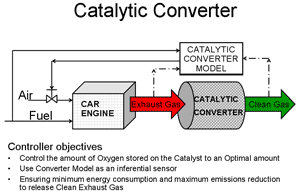
ParOS has developed its parametric controller for stoichiometric control of a three-way catalytic converter. This controller matches the (old) model-based control performance with minimum effort, delivering higher efficiency of the catalytic converter under dynamic operation, which ultimately leads to lower emissions. The ParOS controller will enable overall lower costs for the car system.


The catalytic converter system installed in the exhaust of automobiles to convert harmful gases (CO, NO) to less harmful gases (CO2, N2). For the conversion to take place, an optimal amount of oxygen must be maintained at the catalytic converter. Ceria stores oxygen when there it is in excess and releases it when it is in short supply. This is an example of a situation where a control law is obtained as an explicit function of the state of the system - therefore no need to solve an optimisation problem to compute the optimal value of the control variable.





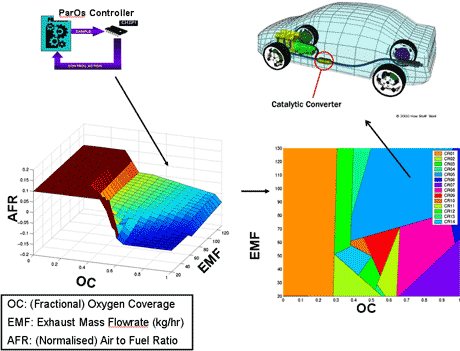
The control variable is Air to Fuel Ratio (AFR) and the state variable is Oxygen Coverage (OC) at the catalyst. Exhaust Mass Flowrate (EMF) is a disturbance since its value depends upon the driving conditions - high EMF if automobile needs to go fast, low EMF if automobile is waiting at a traffic light. The figure on the left shows a number of control laws as an explicit function of the state variable and disturbance and the one on the right shows the regions on the space of state variable and disturbance where each region corresponds to a unique control law. The ParOS solution performs well delivering higher efficiency of the catalytic converter under dynamic operation. For more information, or to set up a trial please contact us at info@parostech.com.

back to Top