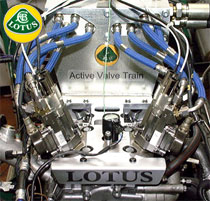
This restriction can be overcome if fully variable electronically controlled valve timings are deployed that depend on engine demand conditions. Fully variable valve timing is sometimes referred to as camless engines, Lotus Engineering's patented Active Valve Train (AVT) system being a specific example.
ParOS, with the support of the UK Department of Trade and Industry Global Watch Secondment Scheme, developed a model-based controller for the electronic regulation of the research (AVT) system at Lotus Engineering. The scheme is an output feedback predictive optimizing controller that was derived off-line using parametric programming techniques. The controller was tuned for a range of given valve profiles and tested experimentally.
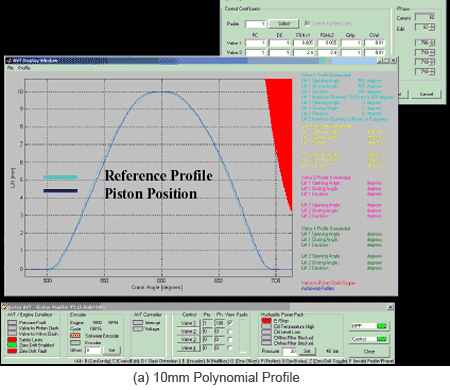
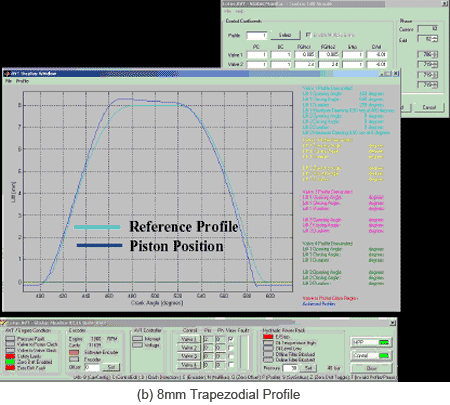
The ParOS controller has been demonstrated running a Lotus AVT actuator at a constant speed, proving that it performs satisfactorily for smooth polynomial profiles and that its tuning does not require the effort and expertise of conventional proportional derivative controllers. The next stage of the work will be to demonstrate the applicability of the controller across a range of engine speeds and loads and to dynamically select the optimal valve profile under changing conditions.
For more information on ParOS solutions for the Automotive industry applications or to discuss a special project, please contact us at info@parostech.com